
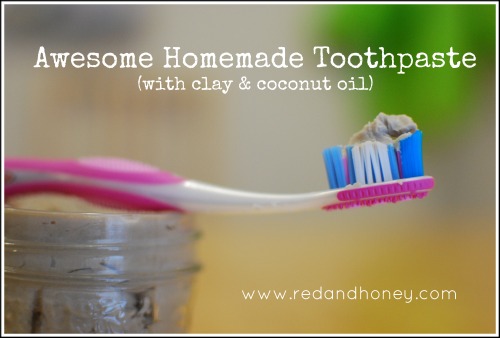
I’ve seen many homemade toothpaste recipes floating around internet-land for a few years now.
Most recipes are a baking soda mixture, and while I have serious respect for the power of baking soda (it’s an awesome tub cleaner!), the thought of it in my mouth makes me scrunch up my nose and keep on buying those danged expensive little tubes of all-natural toothpaste from the local health store.
Then, I saw this post on Keeper of the Home where Stephanie makes homemade clay toothpaste. She essentially made her own Redmond Earthpaste – how awesome is that?! I recently got a tube of Earthpaste in the mail from the ebook bundle freebies, and I am loving it.
Being on a every-penny-pinched kind of budget though, I’m not loving the price. I mean, if you’re going to buy an all-natural flouride-free toothpaste (definitely a good idea if you aren’t going to make your own) then Earthpaste is definitely one of the best out there, and fairly priced too.
However, since I needed a more frugal option I opted to attempt to make my own concoction. (I love how the little things can really add up to big savings in the long run!). Woot woot! It turned out fabulously, and I am sharing the recipe below.
How Frugal Is It Compared to Store-Bought?
Redmond Clay – bought a jar for around $10, used 1/4 cup for a cost of $1.30 (found at a local natural health store)
Organic Virgin Coconut Oil – bought a jar for around $10, used 2 T for a cost of 68 cents.
Xylitol – approximately 25 cents worth (bought at the Bulk Barn, and I don’t honestly remember how much it cost, so this is a guesstimate!)
Peppermint Extract – a small container for around $3, used 2 teaspoons for a cost of 70 cents.
Redmond Real Salt – I only used 1/2 teaspoon of salt, so I didn’t bother calculating it.
Water – free. (OK, so technically I used the water from our Berkey, so maybe it cost a penny or two towards the cost of a new filter in 2-3 years…)
TOTAL COST: $2.93 for 130 ml (I used a little 125ml mason jam jar, and there was a little extra, so we all brushed our teeth and then squished the rest in as best we could!)
Cost of Redmond Earthpaste where I could buy it online (with free shipping here): $6.59 for 113 g.
The bottom line? My homemade version is approximately 60% cheaper!
When you calculate the annual costs for a family of five like ours, brushing our teeth twice a day, you will save approximately $326.50/year!
That’s no small chunk of change, and most definitely worth it in my opinion… especially when you consider the fact that this toothpaste feels and tastes just as good as the regular stuff. I actually find that it makes my teeth and mouth feel smoother and cleaner than ever. I’m guessing that if I were to try and suck it up and use a homemade baking soda kind, I’d likely give up on it eventually.
Why Not Conventional Toothpaste?
The toothpaste brands typically found on store shelves are full of harmful ingredients that you really don’t want to be ingesting; such as sodium lauryl sulfates (SLS), artificial flavours and colourings, parabens, fluoride, glycerin, and more. The EWG (a non-profit information agency) says
“Many people believe that companies are required to test personal care products for safety before they’re sold. It’s not true. While many companies make perfectly safe products, other personal care products that you use every day might be laden with carcinogens or miscellaneous chemicals that no one has ever studied the health effects of.”
SLS’s are one of the worst chemicals found in body care products. It is a chemical foaming agent that has been associated with a host of health issues. Many thousands of scientific medical studies have proven the toxicity of sodium laurel sulfate, and I for one do not want it anywhere near my family if I can help it. It’s in so many conventional body care products these days!
The safety of using fluoride has also come into serious doubt recently. This article has some excellent info. Interestingly, more and more people are starting to recognize the dangers of fluoride, such as the city of Calgary (an hour from Tiny Town!) which has voted to ban all fluoride in the public water supply.
Another ingredient that is in virtually all store-bought toothpaste (even the natural brands!) that I wanted to avoid is glycerin. This relatively harmless ingredient actually wreaks a lot of havoc by leaving a coating on your teeth, which does not allow them to remineralize on their own, leading to more cavities. The book Cure Tooth Decay by Ramiel Nagel is the one most commonly cited by other writers on this subject, though I haven’t personally read it yet myself.
The Amazing Power of Clay
The clay is a fabulous starring ingredient in this toothpaste as it is smooth and mostly tasteless on its own. It has incredible medicinal properties as well so that if you accidentally swallow some it’s totally safe (and even potentially beneficial).
There are a number of scientific studies published that show the power of clay to draw out toxins from the body. It is often used for stomach/bowel upsets, and it has even been proven to have a powerful role in the adsorption of radiation. Toxins are attracted to the clay like a magnet and carried out of the body. This process is called adsorption (spelled with a “d”). Clay has been used therapeutically for thousands of years, and is starting to see a resurgence in popularity once again.
Why I Didn’t Use Essential Oils or Baking Soda
I decided to not use any essential oils because I have concerns about the safety of ingesting them, especially on a daily long-term basis. You may think it doesn’t matter since we spit it out, but since my four-year-old son loves to declare that “Toothpaste is my favourite food, Mommy!” whenever he brushes his teeth, I decided that spitting the toothpaste out was not a safe bet.
I also have concerns about having things in my mouth that I’m not comfortable ingesting due to the absorbing nature of the mucous pathways of our bodies (think eye, nose, mouth, etc).
Some claim that ingesting small amounts of certain higher-quality oils is safe, but even that is not on a daily long-term basis. Either way, essential oils are powerful things, and they can make a person quite sick if used incorrectly.
So, I needed something else for the minty flavour and preferably something else with antibacterial properties. I decided to use peppermint extract and xylitol for taste (minty and sweet), and coconut oil for its antibacterial properties.
You could easily sub in stevia for sweetener if you’d like, but I didn’t for a couple of reasons: 1) I didn’t have any on hand 2) The first brand I’ve tried had a yucky aftertaste and I haven’t wanted to drop the money on trying more to find one I like, and 3) there are many studies citing the benefits of xylitol on reducing or healing cavities.
I also decided to avoid baking soda, which is the basis of most homemade toothpaste recipes, for a couple of reasons. First, because the taste is just gross to me. I’ve also heard conflicting reports about using baking soda on your teeth. Many say that it is too abrasive, and too harsh for daily use on teeth and gums.
The Recipe
1/4 cup Redmond clay
1/3 cup boiling water
2 tablespoons coconut oil
3 teaspoons xylitol
2 teaspoons peppermint extract
1/4 teaspoon salt
Mix clay and salt in a bowl, then add boiling water. Mix well with a hand mixer, then add the rest of the ingredients. Mix all together well, store in an airtight container, and throw out your colgate.
(Edited to add: I find mine fairly stiff in texture, so feel free to add extra hot water (a tablespoon at a time) to get the consistency you want before putting it in the container).
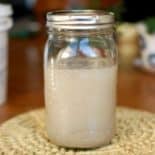
I have mine in a small mason jar for now, and I plan to keep a little butter knife or spoon with it to use to apply the toothpaste to the brush. Dipping it in won’t work because of the potential contamination of bacteria, and the texture is a bit too thick for that to work well anyway.
I love this toothpaste, my family loves it, and there’s no way I’m ever going back!
Have you ever made your own toothpaste?







Bill
You should have mentioned not to use metal to stir or store the toothpaste in as metal can interact with the clay, neutralize its ionic charge, and make it less effective.
Kathy
I make my own toothpaste as well. I took an old toothpaste tube. Cut the big end of it off. Washed it really good and put my toothpaste in the tube. I folded the end up and put a clip on the end. Viola, squeezable toothpaste.
Jo
I used lush’s toothpaste for a while, but like you mentioned the baking soda meant it wasn’t that pleasant. As much as I’d try to ignore it, it does leave a slightly burning sensation when you’ve finished brushing your teeth. This is a really cool idea, thanks for sharing Beth.
Beth
Glad you liked it! Thanks for reading! 😀
Jannison May
I tried your receipe twice, it didn’t go well the first time, the paste was too watery. The second time i actually read your instructions and it worked like a charm. This homemade toothpaste is amazing, cheap and affective. I’ve read somewhere that company toothpastes are really bad for teeth so I’ll be using this receipe from now on. Thank you so much.
Jeff Henkle
I think it is important to not scare people from fluoride as it is supported by the vast majority of the scientific community. The linked source from this post does not have any info as referenced. Interesting about mentioning Calgary banning fluoride in the drinking supply in 2011, a study published last year shows the lack of fluoride in Calgary drinking water led to a rise in kids’ tooth decay, often with full mouth decay! http://www.cbc.ca/news/canada/calgary/tooth-decay-calgary-fluoride-water-1.3450616
I still plan to try the recipe, though for other reasons such as the DIY aspect. 🙂
carol
Dear Boss,
We are a professional stevia manufacturer in china. We recommend our stevia for you.
Product: Stevia Powder
Specification: SG90, RA30
Quantity: 500KG
Price: USD39.9/KG, FOB Shanghai
Delivery: By sea.
Other specification available like: SG90 RA30, SG90 RA50, SG90 RA60, SG95 RA60, SG95RA80, RA97% , RA98% And customerized specification also available.
Certificate Available: Organic certificate, Kosher , Halal, ISO certificate are available.
we also provide liquid stevia
Any comments by return will be highly appreciated.
Best regards
carol
Qufu Haigen Stevia Products Co.,Ltd
China . Shandong . Qufu
Email: [email protected]
Maja
My gums hurt after using your toothpaste, like they’re scratched. Do you have the same?
Karla
My “toothpaste” recipe is different. It’s actually just a combination of essential oils (myrrh, tea tree, peppermint, cinnamon, clove, lemon) and almond oil (for a carrier). So it’s an oil blend, more than a paste. And it’s great for cleaning and breath-freshening.